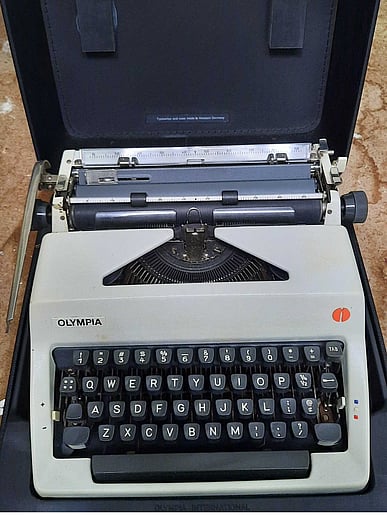
I don't mind you knowing that I'm old enough to remember working on a typewriter. The photo above is of my old Olympia, still looking comfortable in its hard, protective case.
Mom had an Olympia manual typewriter too, one she used for writing letters, typing up recipes, and Dad's specifcations for getting council consents for his various building projects on our houses.
When I was about 12 years old, I started writing my 'books', fabulous adventure stories featuring me, of course, and several of my school mates, taking on evil villains in various scenarios. All of my villains had fast sports cars and very nefarious intentions.
These novels needed to be typed so I 'borrowed' Mom's typewriter. She wasn't keen on this as I used up so many of her ribbons and also my 'touch' was too heavy by far. 'You need a lighter touch,' she'd say, demonstrating this lightness as her fingers touch-typed over the keyboard with speed and proficiency, something I definitely lacked.
However, Mom was not one to stand in the way of my budding literary talents and so she allowed me the use of her Olympia manual, and her carbon paper for copies, and her white-out for the many mistakes I made and, of course, her paper stock, reams of it.
One of the first things I bought when I left home was a typewriter because that's what we used back then. During my years living in the USA, I submitted articles to magazines and newspapers in New Zealand, and these had to typed up and posted through the mail!
I eventually upgraded to a fancy electric typewriter that was all the rage at the time, but could never get used to the 'touch' my Mom so ardently described to me. The touch of the electric was so light that, raised as I had been on the good old manual where some pressure was required, I could never settle into it. Back to my trusty Olympia I went.
Nowadays, typewriters are rather like antiques, and it's hard to use them even if you wanted to, due to the difficulty sourcing the ribbons needed.
A recent article caught my eye: a German language instructor at Cornell University sourced a bunch of typewriters from online sources and thrift shops, and introduced her students to the art of the typewriter, wanting them to understand what things were like before the digital age changed everything.
The students found it an interesting challenge.
A typewriter is not intuitive. It cannot spell check nor can it write for you like AI can. It makes a 'ding' at the end of each line, requiring a manual return of the carriage so you can continue. Also, there are no distractions as we have on our screens these days, like notifications or the temptation to look at your Facebook or Twitter. Knowing there is no 'delete' key makes one think more carefully about one's words, and many students complained their fingers weren't strong enough to touch type, using index fingers instead.
An interesting experiment indeed, a trip back to 'the way we were', and worth remembering that some of the greatest works from writers were created on typewriters without the aids we now take for granted.
Take that, Artificial Intelligence!